
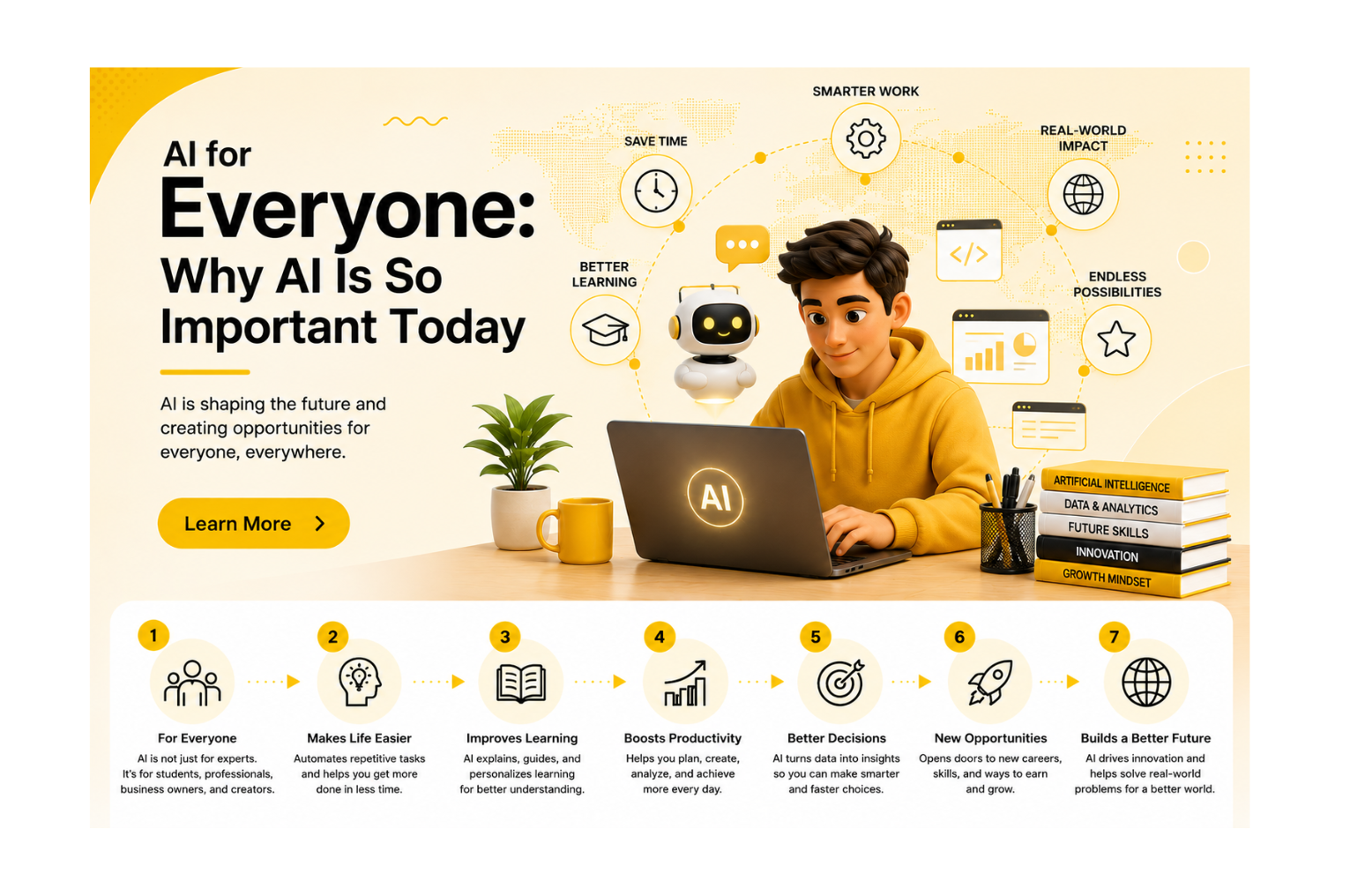
AI for Everyone: Why AI Is So Important Today
A few years ago, Artificial Intelligence (AI) seemed like something only scientists and large technology companies are able to used it. But today, that all has changed completely.
Whether you're a student preparing for exams, a professional trying to save time, a business owner looking to grow, or someone simply curious about technology, for every work AI is already part of your daily life.
From unlocking your smartphone with Face ID to receiving personalized recommendations on YouTube and Netflix, AI is quietly making everyday tasks faster, smarter, and more convenient.
The biggest question is no longer that "Will AI become important?"
Whether you're a student preparing for exams, a professional trying to save time, a business owner looking to grow, or someone simply curious about technology, for every work AI is already part of your daily life.
From unlocking your smartphone with Face ID to receiving personalized recommendations on YouTube and Netflix, AI is quietly making everyday tasks faster, smarter, and more convenient.
The biggest question is no longer that "Will AI become important?"
The real question is:
"How can I use AI to improve my life and career?"
"How can I use AI to improve my life and career?"
This blog explains everything that you need to know.
What Is Artificial Intelligence?
Artificial Intelligence (AI) is a technology that enables computers and software to perform tasks that normally require human intelligence.
These tasks include:
Solving problems, Learning from data, Recognizing images, Making recommendations, Generating content, Answering questions
Think of AI as a smart assistant that helps people to do their work moreefficiently.
Why Is AI So Important Today?
Technology is advancing faster than ever, and AI is driving much of that progress.
Why Is AI So Important Today?
Technology is advancing faster than ever, and AI is driving much of that progress.
It helps people:
• Save valuable time
• Increase productivity
• Make better decisions
• Reduce repetitive work
• Learn new skills faster
Those who understand how to use AI effectively are often able to work faster, solve problems more efficiently, and adapt to changing workplace demands.
AI Is for Everyone – No Matter Who You Are
One of the biggest misconceptions about Artificial Intelligence is that it's only for technology experts or for the people who are working in the IT industry.
In reality, AI isn't designed for a particular profession or age group. It's designed to help people solve everyday problems more efficiently and easily.
Whether someone wants to learn something new, save time, organize daily work, make better decisions, create content, or simply complete routine tasks faster, AI can help there.
The value of AI doesn't depend on who you are. It depends on how you use it.
That's why AI is becoming a Powerful skill that benefits to almost everyone.
Why AI Matters to Everyone
In today's fast-moving world, people are expected to process more information, make quicker decisions, and stay productive despite limited time. AI helps by reducing repetitive work, organizing information, generating ideas, answering questions, and assisting with everyday tasks. Instead of replacing human abilities, AI enhances them, allowing people to focus more on creativity, critical thinking, and meaningful work.
How AI Is Transforming the Way We Work
AI is changing the way people approach in everyday work and responsibilities. Rather than replacing human skills, AI helps people work more efficiently by reducing repetitive tasks, improving accuracy, and saving valuable time. It allows individuals to focus more on creativity, problem-solving, communication, and decision-making instead of spending hours on routine activities.
How AI Is Creating New Opportunities
How AI Is Creating New Opportunities
Learning AI doesn't mean everyone needs to become an AI engineer or programmer. Many modern roles now require basic AI knowledge to improve productivity, solve problems, analyze information, create content, or support better decision-making. People who understand how to use AI tools effectively are often better prepared for the changing workplace and future career opportunities.
Common Myths About AI
Myth 1: AI Will Replace Everyone's Job
Reality:
AI is changing jobs, not eliminating all of them. Many roles will evolve, requiring people to work alongside with AI.
Myth 2: AI Is Only for Programmers
Reality:
Teachers, designers, marketers, writers, students, entrepreneurs, and healthcare professionals all are using AI today.
Myth 3: AI Knows Everything
Reality:
AI can make mistakes. Human judgment, fact-checking, and critical thinking remain are essential.
Why Learning AI Is Becoming Essential
Why Learning AI Is Becoming Essential
Artificial Intelligence is no longer just a skill that reserved for software engineers or data scientists. Today, AI is becoming a basic digital skill, just like using the internet, email, or office software. Whether you're a student, teacher, freelancer, entrepreneur, or working professional, understanding how to use AI can help you save time, improve productivity, and make better decisions.
Learning AI doesn't mean you need to build robots or write complex code. It means knowing how to use AI tools to solve everyday problems. From writing emails and creating presentations to analyzing data and generating ideas, AI can make many daily tasks easier and more efficient.
As more companies adopt AI, people who understand how to work alongside AI will have a significant advantage in their careers. Learning AI today is an investment in your future.
Popular AI Tools You Can Start Using Today
Popular AI Tools You Can Start Using Today
One of the best things about AI is that many powerful tools are available to everyone. You don't need expensive software or technical expertise to get started.
Some popular AI tools include:
• ChatGPT – Helps with writing, brainstorming, coding, learning, and research.
• Google Gemini – Assists with search, productivity, and Google Workspace tasks.
• Microsoft Copilot – Enhances Word, Excel, PowerPoint, and other Microsoft applications.
• Canva AI – Creates presentations, graphics, and social media designs quickly.
• Grammarly AI – Improves grammar, clarity, and writing style.
• Perplexity AI – Provides AI-powered answers with sources for research and learning.
These tools can help users to complete tasks more efficiently.
The Future of AI
AI will continue to become more capable and more accessible.
Over the next few years, we can expect AI to:
• Personalize education further
• Improve healthcare outcomes
• Enhance workplace productivity
• Create new job opportunities
Every person who start learning AI today, will be better prepared for tomorrow's workplace.
The future of AI is not about replacing people - it is about helping people to achieve more with the right combination of technology and human skills. Those who understand how to use AI responsibly, think critically, they are capable to adapt new technologies and will be better prepared for the opportunities and challenges for the future.
Conclusion
Conclusion
AI is no longer just a technology for the future. It is becoming the part of the present.
From education and healthcare to business and everyday productivity, AI is changing how we learn, work, communicate, and solve problems.
The goal isn't just to let AI think for you. The goal is to use AI thoughtfully to work smarter, learn faster, and create more value.
The people who want to succeed in the coming years, they won't necessarily be those who know the most about AI. They'll be the ones who know how to use AI effectively, responsibly, and creatively.
Start learning today, keep practicing, and stay curious. AI is becoming a skill for everyone, and the sooner you begin, the more opportunities you'll unlock.