
ARTIFICIAL INTELLIGENCE - HISTORY & EVOLUTION
INTRODUCTION TO ATIFICIAL INTELLIGENCE-
Artificial intelligence is a field of computer science that focuses on making machines intelligent or creating system that can perform tasks that typically requires human intelligence such recognising, making predictions, and solving problems.
We all are probably using ai without even realising it:
- ChatGPT- is an AI assistant made by openAI that answers all the queries, helps in writing, coding, analysis, and various other tasks.
- Self-driving cars – concept of machine learning is used in the concept of making self-driving cars to route the correct direction, recognize an obstacle, follow traffic rules, or just adjust the speed.
- Siri-main technology used in siri (VOICE ASSISStant) is natural language processing where the speech is converted into text → understands words → finds information → responds.
- Google translate- in this application, ai is used in the form of deep learning which uses neural network- inspired from human brain , with layers of connections that process information.
Well, in this article you will learn about the history and evolving period of artificial intelligence, while many assumes artificial intelligence a recent phenomenon driven by recent breakthroughs like ChatGPT, but the origin reaches back over a century.
WHY AI MATTERS TODAY?
AI or artificial intelligence is no longer a something from science fiction movie, and has become a very crucial part of our lives, from powering smart phones, optimizing business operations to Pioneering
Healthcare and combatting climate change. Apart from transforming our lives for better, it is also redefining our work, the way we live and connect; so why does ai matters in 2026?
FROM TODAY'S IMPACT TO YESTERDAY'S VISION
The ai transforming our world in 2026 driving trillion-million-dollar markets, revolutionizing healthcare, and reshaping education; didn’t appear overnight.
Behind every smart assistant, diagnostic algorithm lies decades of visionary thinking, ambitious experimentations and hard-earned breakthroughs.
To truly understand where ai is headed, we need to look back at where it began.
CHANGE IN BUSINESS AND ECONOMY –
Artificial intelligence has emerged as one of the most powerful drivers of global economic expansion. The worldwide ai market was roughly valued at USD 279 billion in 2024, and is expected to cross USD 360 billion dollar and 2030 it will reach the mark of USD 1.8 trillion dollar, this rapid rise highlights the growing role of artificial intelligence in modern economies.
- Increase in productivity- companies adapting artificial intelligence notices productivity improvement by the mark of 40% , as automation takes over the repetitive and time taking tasks.
- Faster innovations- AI- powered research tools accelerate drug discovery, streamline manufacturing and reduces development costs which fuels faster product launch.4
Together, these points make a thing clear, to adapt ai as risking it will welcome more tech driven rivals.
- ADVANCEMENT IN HEALTHCARE FACILITIES
AI is reedifying healthcare by improving diagnosis accuracy, personalizing treatments, and reducing administrative burdens.
-
-
- Improved diagnostics- advance algorithms now analyse images with accuracy comparable to professionals enabling earlier detection of serious conditions
- Tailored care- by combining generic behavioural details, ai system designs personalized treatment plan that enhances recovery and minimizes side effects.
-
Industry surveys indicates that more than 85% of major healthcare institutions now use AI in clinical operations.
- RESHAPING EDUCATION AND CONTINUOUS LEARNING
Across schools, universities, digital platforms ai is transitioning the way of delivering knowledge and how is it assessed.
-
-
- Personalized training paths- adaptive system adjust lessons in real time based on student progress and ensuring customized support for every user.
- Early intervention: Predictive analytics help institutions identify struggling students by monitoring attendance, participation, and academic trends.
-
Driven by these innovations, the AI-powered education sector is projected to grow into a multi-billion-dollar industry by 2025.
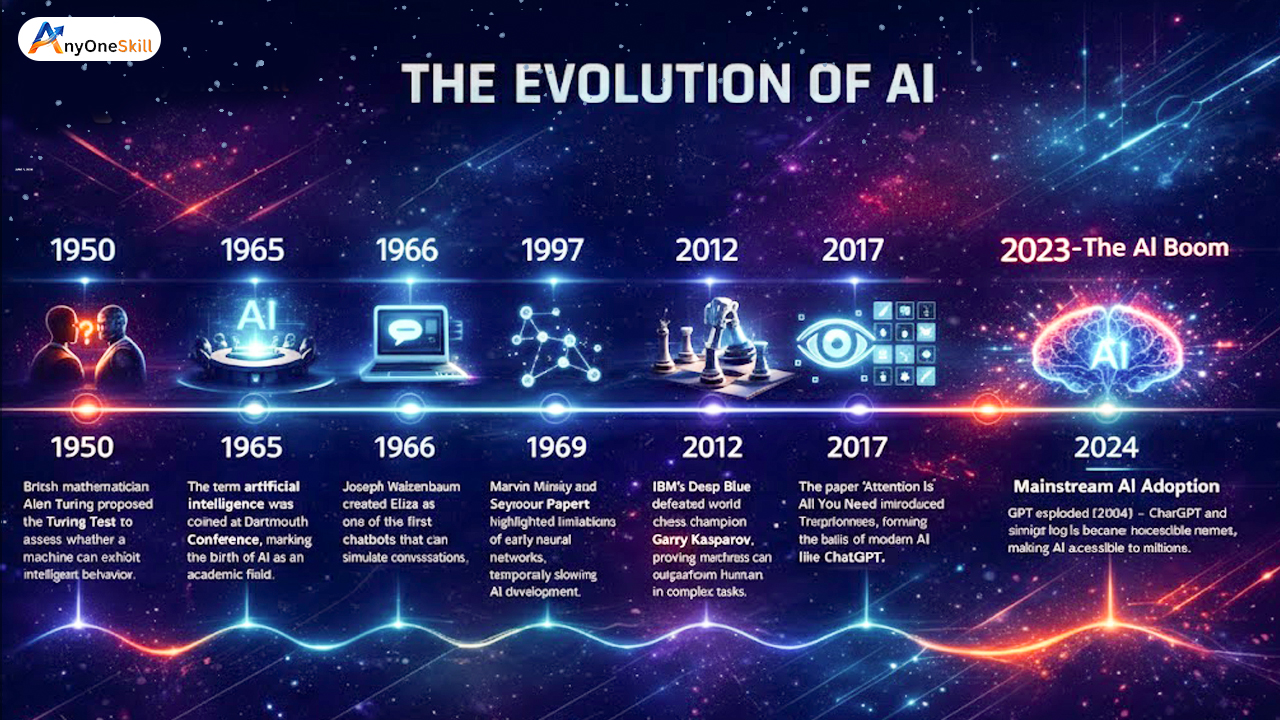
The journey of artificial intelligence started over seven decades ago marked by groundbreaking innovations, setbacks, and remarkable comebacks. Staring from-
1950- THE FOUNDATIONI- TURING TEST PERIOD
British mathematician Alan Turing proposed the famous “Turing Test" to determine whether a machine could exhibit intelligent behaviour indistinguishable from human. This laid the philosophical foundation for AI research.
1965- 1966- EARLY CONVERSATION AI
Dartlewood : "AI" Coined (1965)- the term artificial intelligence was officially coined at the Dartmouth Conference, marketing the birth of AI as an academic discipline.
Eliza chatbot(1966)-
Joseph Weizenbaum created Eliza as a, one of the first chatbots that can stimulate conversations.
1969 - Perceptrons Criticized
Marvin Minsky and Seymour Papert published research highlighting limitations of early neural network (perceptrons), which temporarily slowed AI development in this area.
1974-1980 - THE FIRST AI WINTER
In the history of artificial intelligence, an AI winter is a period of reduced funding and interest in AI research. This field has experienced several disappointments and criticism, followed by
- Renewed interest over a period of time
WHY IS IT CALLED “WINTER”?
Just like winter slows natural growth, an ai winter represents a time period when-
- Innovation slows
- Investment drops
- Public confidences decrease
- AI winter is a period when enthusiasm and funding for AI decline due to unmet expectations.
1997 - Deep Blue Triumphs
IBM’s deep blue defeated world chess champion Garry Kasparov, proving machines can outperform human in complex tasks.
2011 - Watson Wins Jeopardy!
IBM demonstrated advance natural language understanding by defeating human champions on the quiz show Jeopardy!, showcasing ai’s ability to understand and process human language.
2012 - The Deep Learning Revolution Begins
Alexnet won the Imagenet competition using deep learning, dramatically improving image recognition accuracy and sparking renewed interest in neural network.
2017 - Transformers and Generative AI Emerge
The “attention is all you need” is paper introduced the transformers architecture, revolutionizing how ai processes language and laying groundwork for modern AI like ChatGPT.
2020-2023 - The AI Boom
This refers to the period when artificial intelligence transitioned from research labs to mainstream public awareness and everyday use. This era saw a explosive growth in AI.
2024-2026 - Mainstream AI Adoption
GPT exploded (2024)- ChatGPT and similar tools became household names, making AI access to millions.
Large Language Models & Advanced Applications (2025-2026) -
Ai continues to evolve with more sophisticated language models, personalized AI assistant and advanced reasoning capabilities transforming how we work, live etc
FROM HISTORY TO TOMMOROW
Understanding AI's history is just the first step. If you're ready to move from observer to practitioner, join our comprehensive AI course designed for beginners and professionals alike.
**What You'll Learn:**
- Practical AI tools and applications
- Machine learning fundamentals
- Real-world AI project implementation
- Ethical AI development practices
Whether you're looking to advance your career, start a new venture, or simply understand the technology shaping our future—this course will equip you with the skills that matter in 2026 and beyond.