
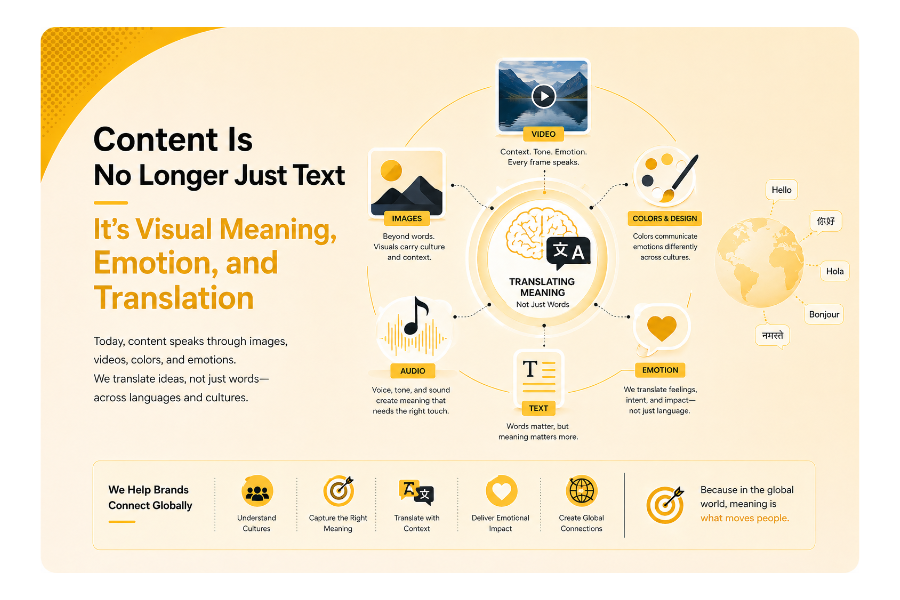
Content Is No Longer Just Text It’s Visual Meaning, Emotion, and Translation
"Images Shout, Words Speak: The Translator's Challenge"
Maybe the last time you smiled was because of an image, not a person. I prefer
images over humans. My name is — because moments feel magical when they pause, like a flowing river frozen into ice.
images over humans. My name is — because moments feel magical when they pause, like a flowing river frozen into ice.
“Because one paused moment can hold more meaning than a thousand moving ones.”
Images are both crucial and majestic at the same time. And for translators like us, they are more than just tools— they help us convey meaning, express emotion, and make people feel exactly what they were meant to feel.
Our Right to Be Part of a Journey
Images carry journeys—joy, sorrow, and strength.
Image translation turns that power into meaning.
Image translation turns that power into meaning.
Because an image isn’t just a visual; it is proof of who someone once was. And translating it? That’s touching a heart without knocking.
This isn’t a game of emotions. It’s an attempt to understand what truly matters— the importance of meaning, context, and connection, not only for translators, but for everyone.
What is image translation? Before moving forward, it’s essential to clarify what we’re talking about or why it should be used. Translation is not limited to words alone.
Long before written language existed, images were already communicating meaning. A child learns to recognize images before understanding words.
That is exactly what image translation builds on — translating meaning , context , and intent embedded within visuals so that they can be understood across languages and culture.
Why image translation matters now?
Widespread Need
There is a routine requirement for translated graphics, infographics, marketing materials, and presentations.
It is also necessary with USER INTERFACE (UI) ELEMENTS —the visual components people interact with in apps, websites, and games.
It is also necessary with USER INTERFACE (UI) ELEMENTS —the visual components people interact with in apps, websites, and games.
For instance:
-
Buttons (like “Submit,” “Cancel,” “Buy Now”)
-
Menu items and navigation tabs
-
Form labels (“Name,” “Email,” “Password”)
Why does it matter for translation?
Image translation plays a crucial role in helping people understand concepts and documents. Information doesn’t always come in written text; sometimes the message appears in the form of an image. Should we ignore it? No.
That is exactly why image translation has become an essential skill for translators today.
That is exactly why image translation has become an essential skill for translators today.
Technical Evolutions
Over time, the tools and techniques available for handling image translation have significantly improved.
Earlier, translators had to manually retype all the text from an image before translating it, after which the visual recreation process would begin. This approach strained the entire workflow, resulted in long turnaround times, and required access to expensive software such as Photoshop. Basically, image translation felt like a task rather than a skill.
And that is precisely why the question has emerged today:
Is image translation truly useful for translators now?
Is image translation truly useful for translators now?
Competitive Advantage
Translation agencies increasingly seek translators who can handle image translation as a complete process, not just extract text and return a translated version.
Being able to deliver ready-to-use content—where the translated text fits naturally into the image—makes you far more remarkable in today’s market.
This approach does more than explaining information.
It gives the audience the opportunity to connect, understand, and visualize the message as it was originally intended.
It gives the audience the opportunity to connect, understand, and visualize the message as it was originally intended.
Treat image translation as a competitive advantage—and learn to utilize it strategically.
As the translation industry evolves, pure text-based translation is becoming more standardized, whereas specialized skills like multimedia localization and image translation open doors to more advanced and rewarding opportunities.
If this made you curious about how image translation actually works in real projects—from UI elements to marketing visuals—then learning it the right way matters.
Anyoneskill is built to help translators turn images from a task into a professional advantage.
Explore the course here:
CONCLUSION
Images are more than visuals— they are frozen moments of meaning, emotion, and human connection.
As translators, our role is not just to convert words, but to preserve the heart behind them.
As translators, our role is not just to convert words, but to preserve the heart behind them.
Mastering image translation doesn’t just make us better professionals; it allows us to bridge worlds, touch hearts, and give life to the stories that words alone cannot tell. My Name