
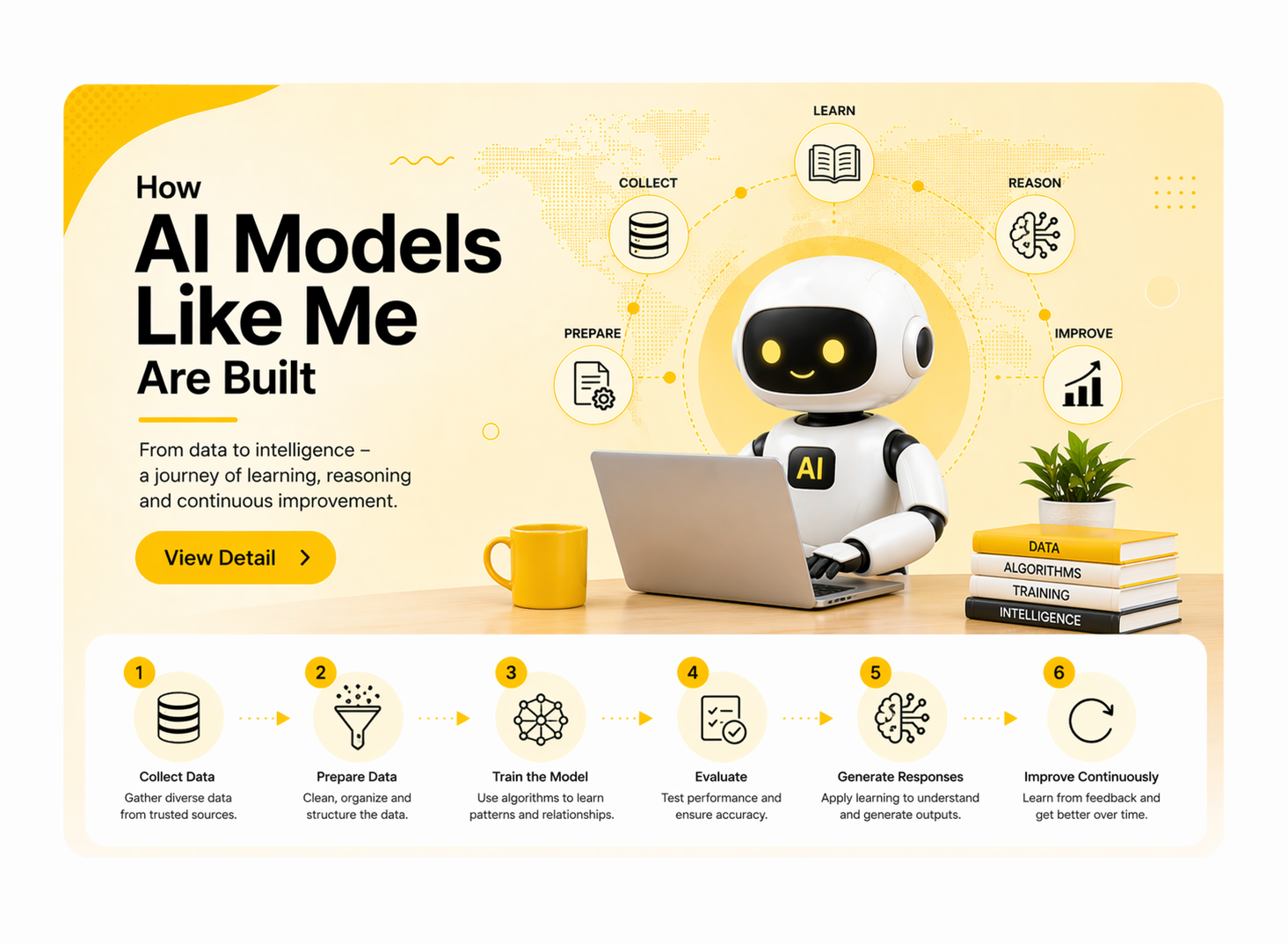
How AI Models Are Built From Data to Human-Like Intelligence
Think of training an LLM in three broad phases:
Phase 1: Learning from a massive reading binge (Pretraining)
Imagine reading billions of web pages, books, and articles, and your only job is to guess the next word in every sentence. Do that trillions of times and you start to pick up grammar, facts, reasoning patterns, and how ideas connect. That's essentially what pretraining is — the model learns by predicting missing or upcoming words at a huge scale. This requires enormous computing power (thousands of specialized chips running for months) and carefully curated data.
Phase 2: Learning to be helpful (Instruction Tuning)
After pretraining, the model is very knowledgeable but kind of awkward — it might just continue text rather than actually answer you. So it gets a second round of training on examples of real questions paired with good answers. This teaches it to follow instructions, stay on topic, and respond like an assistant rather than a text autocomplete engine.
Phase 3: Learning what humans actually prefer (Preference Optimization / RLHF)
Even after instruction tuning, some responses are better than others in subtle ways — more accurate, safer, better-written. Human raters compare different responses and say which one is better. The model then learns from those preferences, nudging itself toward outputs people actually like. This is often called RLHF (Reinforcement Learning from Human Feedback).
Bonus: Fine-tuning for specific jobs
Bonus: Fine-tuning for specific jobs
Finally, a general model can be further trained on specialized data — medical records, legal documents, financial reports — to make it better at specific domains.
The rough analogy: pretraining is school, instruction tuning is job training, and preference optimization is ongoing feedback from your manager until you're really good at the role.
Phase 2: Learning to be helpful (Instruction Tuning)
After pretraining, the model is very knowledgeable but kind of awkward — it might just continue text rather than actually answer you. So it gets a second round of training on examples of real questions paired with good answers. This teaches it to follow instructions, stay on topic, and respond like an assistant rather than a text autocomplete engine.
Phase 3: Learning what humans actually prefer (Preference Optimization / RLHF)
Even after instruction tuning, some responses are better than others in subtle ways — more accurate, safer, better-written. Human raters compare different responses and say which one is better. The model then learns from those preferences, nudging itself toward outputs people actually like. This is often called RLHF (Reinforcement Learning from Human Feedback).