
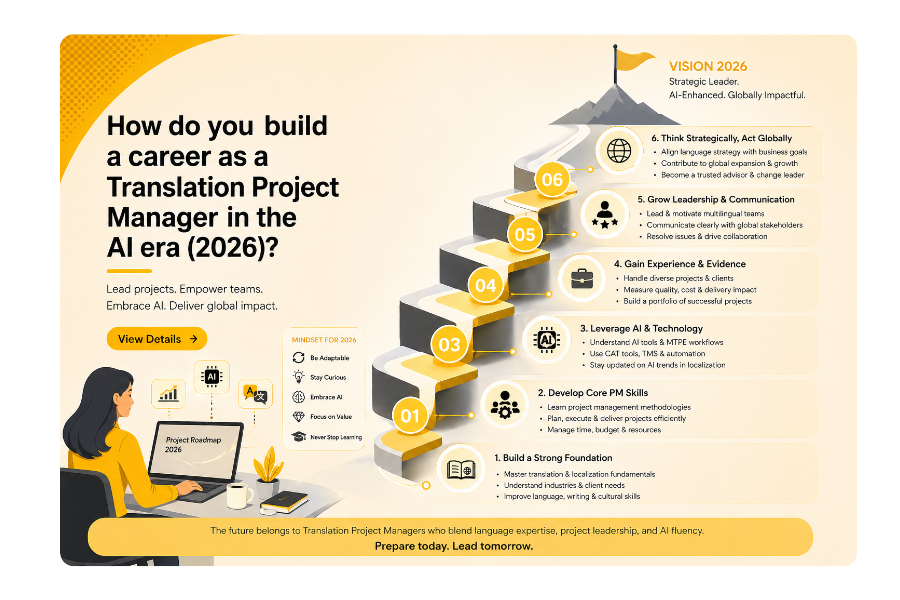
How do you build a career as a Translation Project Manager in the AI era (2026)?
My uncle is a Translation Project Manager, yet he has often struggled to fully understand his own professional voice and identity. Over time, he made me realize that he is not alone—many of us in this field are still navigating what our role truly means.
The rise of AI demandsX evolution, and Translation Project Managers are no exception. The profession is no longer just about managing projects; it’s about adapting, redefining value, and growing alongside technology rather than resisting it.
The evolution of roles has always been a constant. What truly matters, however, is not getting lost in the voices of others, but learning how to find—and own—your own voice within that change.
What Is an Identity Crisis?
Understanding Identity Crisis
An identity crisis doesn’t deny where you belong. Instead, it quietly signals that the space you’ve been working or living in now needs renovation. It has nothing to do with rebuilding your profession—but everything to do with rebuilding your mindset.
My uncle’s struggle was not with his profession, but with finding where his strengths fit within it.
As the atmosphere around his role changed, he learned to adjust his mindset rather than abandon his identity. In doing so, he didn’t lose himself to change—he discovered himself through it.
The Shift in Translation Management: Traditional Practices vs. the New Reality
To understand where the profession is heading, it is necessary to know where it started from.
Traditionally Involved Role
In the traditional setup, the role was centered on creating clear and accurate coordination between translators and clients—acting as the bridge that kept communication and expectations aligned.
Managing Timelines and Budgets
Traditional project managers were also responsible for managing timelines and budgets—one of the most significant aspects of the translation profession, traditionally handled through established manual processes.
Manual Quality Control and Process Oversight
Traditionally, quality checks relied heavily on manual processes and the expertise of project managers. They ensured data security, accuracy, consistency, and close collaboration with clients to obtain correct reviews and approvals—often without any AI or automated support.
Why AI Entered the Picture
These factors paved the way for AI tools to be embraced—not as something to fear, but as a means to help professionals reach their highest potential.
AI emerged not to replace professionals, but to support them where manual techniques become restrictive.
Taking the Next Step Forward
The simplest way to grow as a Translation Project Manager is to remain aware of industry trends. Awareness allows professionals to recognize both threats and opportunities—and confidently take the next step forward.
Growth, in this context, is not about abandoning experience. It is about expanding it.
What AI Actually Does
AI serves as a powerful support in translation project management. While the project manager organizes and oversees the workflow—similar to arranging stones—AI enhances and refines the output, like adding the finishing touches to each stone.
Similarly, the software tools available to Translation Project Managers help them maximize efficiency, ensure quality, and make informed decisions. These tools identify potential challenges, optimize processes, and bring out the best performance from both the team and the project.
The New Reality
Evolution of Neural Machine Translation
The neural machine translation revolution has introduced several advanced platforms such as:
-
DeepL (launched in 2017)
-
Google Translate
-
Microsoft Translator
-
Amazon Translate
-
ModernMT
AI-Powered Translation Management Systems
Modern Translation Management Systems now include:
-
Smartcat
-
Phrase
-
MemoQ
-
Lokalise
-
Crowdin
and many other advanced AI-powered platforms.
Translation Quality Estimation
Tools such as TAUS DQF and Unbabel use AI to evaluate machine translation quality without requiring a human reference. Low-confidence segments are automatically routed to human translators.
Predictive Translation
Systems such as SDL Trados Studio now offer AI-powered Autosuggest, which predicts translations while translators type.
Automated QA
AI tools can automatically detect:
-
Terminology inconsistencies
-
Formatting errors
-
Context mismatches
Smart Routing
AI-enabled platforms can automatically assign content to either machine translation or human translation depending on:
-
Complexity
-
Subject matter
-
Quality requirements
Impact of AI Features
AI has created a hybrid work environment where machines reduce repetitive pressure on humans while improving the overall quality and efficiency of translation workflows.
What AI Does Not Change
AI does not replace or diminish your skills or abilities. Instead, it expands your capabilities by enabling wider connectivity, faster access to information, and more efficient decision-making.
When used effectively, AI strengthens a professional’s reach and impact, allowing them to manage complex workflows and collaborations at a much broader scale.
The New Value Proposition
As AI continues to evolve, the role of the Translation Project Manager becomes more valuable—not less.
AI accelerates processes and expands possibilities, but it does not replace human judgment. Instead, it shifts the focus of the project manager from routine coordination to strategic leadership.
AI can generate translations at scale, but it cannot fully understand client intent, cultural sensitivity, or business impact.
The Translation Project Manager bridges this gap—ensuring that speed does not compromise quality and automation does not override accountability.
With AI increasing connectivity across languages, markets, and teams, projects become larger and more complex.
In this environment, the project manager acts as the anchor—aligning technology, talent, and timelines.
AI may power the engine, but the Translation Project Manager decides the direction. This is why, as AI advances, the proportional value of this profession continues to grow.
Practical Steps Forward
Every step we take must be practical and aligned with AI-driven workflows. This approach ensures continuous upskilling and keeps professionals ahead of traditional translation management practices.
Understanding change is important—but real growth happens when you begin learning and applying the right skills.
As Translation Project Management evolves with AI, professionals need clear, practical, and guided learning, not random information.
Building a Future-Ready Career with Anyone Skill
Platforms like Anyone Skill help Translation Project Managers build strong fundamentals, understand AI-supported workflows, and confidently handle real projects.
Structured learning makes it easier to grow with industry changes instead of feeling overwhelmed by them.
If you want to build a strong and future-ready career as a Translation Project Manager, enroll with Anyone Skill and take the next step forward today.