
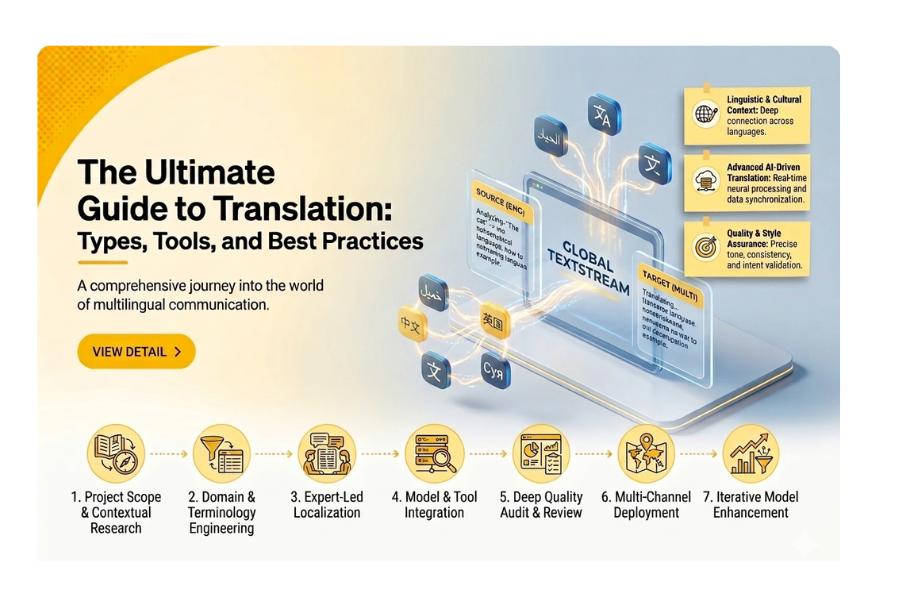
The Ultimate Guide to Translation: Types, Tools, and Best Practices
Introduction
In today’s globalized world, translation plays a crucial role in connecting people, businesses, and cultures. From translating websites, documents, and apps to localizing marketing campaigns, translation ensures that your message reaches audiences accurately and effectively.
What is Translation?
Translation is the process of converting text or speech from one language into another while maintaining its original meaning, tone, and context. Unlike simple word-for-word conversion, professional translation considers cultural nuances, idiomatic expressions, and audience expectations.
Types of Translation
Literary Translation
Focuses on books, poems, and creative content, capturing style and emotion.
Focuses on books, poems, and creative content, capturing style and emotion.
Technical Translation
Deals with manuals, guides, and scientific documents requiring domain-specific knowledge.
Legal Translation
Covers contracts, agreements, and legal texts with strict adherence to legal terminology.
Medical Translation
Involves medical reports, patient records, and pharmaceutical documentation.
Localization
Adapts content to fit cultural and regional specifics, commonly used in websites, software, and marketing campaigns.
Key Techniques for Effective Translation
Understand the Source Material
Thorough comprehension of the original text is essential.
Thorough comprehension of the original text is essential.
Cultural Awareness
Consider idioms, metaphors, and cultural references.
Consistency
Use translation memory tools to maintain consistent terminology across projects.
Proofreading and Editing
Every translation must be reviewed to ensure accuracy and fluency.
Translation Tools That Professionals Use
CAT Tools (Computer-Assisted Translation)
Tools like SDL Trados, MemoQ, and Wordfast help streamline large translation projects.
Tools like SDL Trados, MemoQ, and Wordfast help streamline large translation projects.
Glossaries and Style Guides
These ensure uniform terminology and consistent tone throughout the translation.
Machine Translation
Tools such as Google Translate or DeepL can provide a quick draft, but they still require human editing to ensure quality and accuracy.
The Importance of Professional Translation
Accurate translation is more than just converting words—it’s about conveying meaning and intent. Poor translations can harm your brand reputation, cause misunderstandings, and even lead to legal issues. Professional translators combine linguistic expertise with cultural understanding to ensure that content resonates with its intended audience.
Conclusion
Translation is a vital bridge in our interconnected world. Whether for business, literature, or technology, high-quality translation ensures that your message crosses borders seamlessly. Investing in professional translation services not only saves time but also preserves meaning, tone, and context—making communication truly universal.