
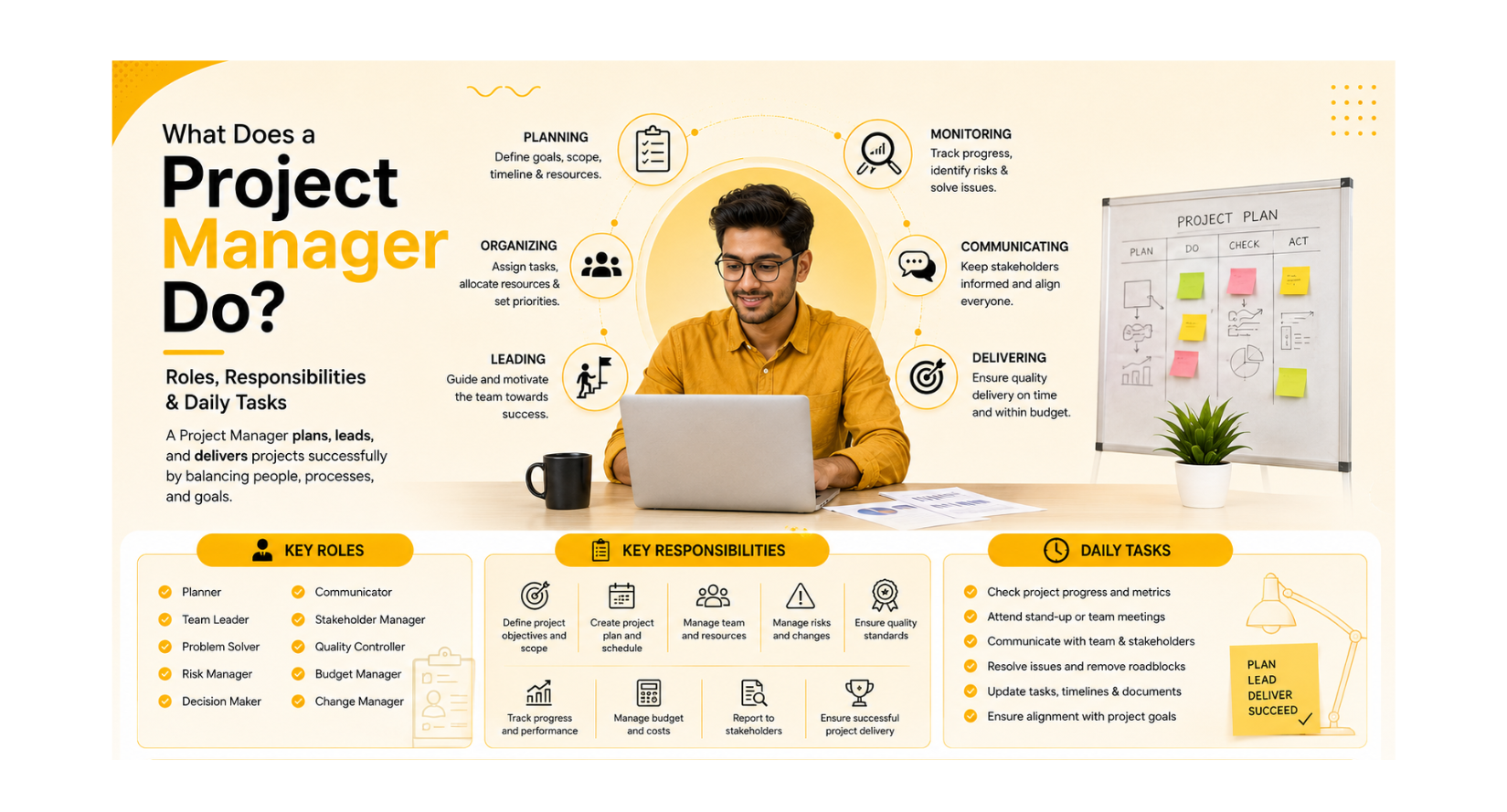
What Does a Project Manager Do? Roles, Responsibilities & Daily Tasks
1. Builds and Coordinates the Team
Projects often require people with different skills.
A Project Manager may work with developers, designers, analysts, writers, testers, sales teams, or external partners. They coordinate these people and make sure everyone understands their responsibilities.
A Project Manager may work with developers, designers, analysts, writers, testers, sales teams, or external partners. They coordinate these people and make sure everyone understands their responsibilities.
The Project Manager does not necessarily do every task themselves. Instead, they help the right people work together effectively.
2. Creates and Manages the Project Schedule
Every project has deadlines.
A Project Manager creates a schedule that shows when tasks should start and finish. They monitor progress and identify delays before they become major problems.
A Project Manager creates a schedule that shows when tasks should start and finish. They monitor progress and identify delays before they become major problems.
If one task is delayed and affects several other tasks, the Project Manager may adjust the schedule or change priorities to keep the project moving.
3. Manages the Budget and Resources
Projects require resources such as money, people, software, equipment, and time.
A Project Manager monitors how these resources are being used and tries to keep the project within its approved budget.
They may also identify when additional resources are needed and communicate those requirements to management or clients.
4. Identifies and Manages Risks
Every project has risks.
A supplier may be delayed, a technical problem may occur, a team member may become unavailable, or project requirements may change.
Project Managers identify potential risks early and create plans to reduce their impact.
The goal is not to eliminate every risk. It is to prepare for possible problems and respond to them effectively.
5. Communicates With Stakeholders
Communication is a major part of project management.
Project Managers regularly communicate with team members, clients, senior management, and other stakeholders. They provide updates, discuss challenges, clarify requirements, and report project progress.
A Project Manager may conduct meetings, send progress reports, maintain project documentation, and communicate important changes.
Strong communication helps everyone stay informed and aligned.
6. Monitors Project Progress
Planning a project is only the beginning. A Project Manager must continuously monitor its progress.
They compare actual progress with the original schedule, budget, and objectives. If something is going wrong, they take corrective action.
This could involve changing priorities, reallocating resources, adjusting deadlines, or solving problems with the team.
7. Ensures Quality
Completing a project on time is not enough if the final result does not meet expectations.
Project Managers work with the team to make sure project deliverables meet the required standards and requirements.
They may coordinate testing, reviews, approvals, and quality checks throughout the project.
8. Closes the Project
A Project Manager's responsibility does not end when the main work is completed.
They help ensure that all deliverables are finalized, documentation is completed, stakeholders approve the work, and remaining tasks are closed.
After completion, the team may also review what worked well and what could be improved in future projects. This process is often called a lessons-learned review.
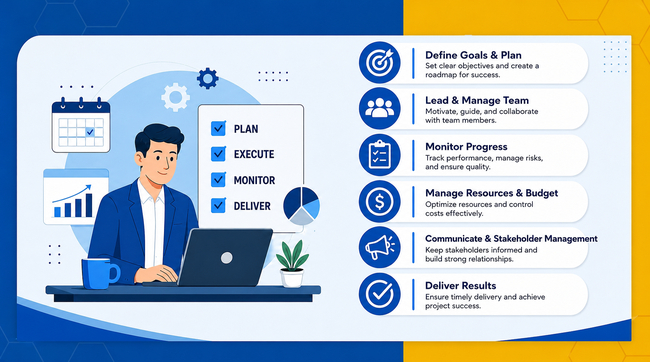
Roles, Responsibilities & Daily Tasks of a Project Manager
A Project Manager plays a key role in making sure a project moves in the right direction from start to finish. Their work involves planning, coordinating people, managing resources, tracking progress, solving problems, and keeping everyone focused on the project goals.
Although the exact role can vary by industry and project type, most Project Managers have three main areas of work: managing the project, supporting the team, and ensuring successful delivery.
Key Roles of a Project Manager
A Project Manager can take on several roles throughout a project:
1. Planner
They create a clear project plan, define priorities, set timelines, and determine what needs to be completed at each stage.
They create a clear project plan, define priorities, set timelines, and determine what needs to be completed at each stage.
2. Team Coordinator
They bring different team members together, assign responsibilities, and make sure everyone understands their tasks and deadlines.
They bring different team members together, assign responsibilities, and make sure everyone understands their tasks and deadlines.
3. Decision-Maker
When problems or unexpected changes occur, the Project Manager evaluates the situation and makes decisions to keep the project moving.
When problems or unexpected changes occur, the Project Manager evaluates the situation and makes decisions to keep the project moving.
4. Communicator
They act as a connection between the project team, clients, management, and other stakeholders by sharing updates and important information.
They act as a connection between the project team, clients, management, and other stakeholders by sharing updates and important information.
5. Problem-Solver
They identify issues, understand their impact, and work with the team to find practical solutions.
They identify issues, understand their impact, and work with the team to find practical solutions.
6. Project Controller
They keep track of the project's timeline, budget, resources, quality, and overall progress to make sure the project stays on track.
Key Responsibilities of a Project Manager
They keep track of the project's timeline, budget, resources, quality, and overall progress to make sure the project stays on track.
Key Responsibilities of a Project Manager
The roles above describe how a Project Manager contributes to a project. Their responsibilities describe the specific work they are expected to manage.
1. Planning the Project
A Project Manager defines project goals, creates a plan, identifies important tasks, sets deadlines, and determines the resources required.
A Project Manager defines project goals, creates a plan, identifies important tasks, sets deadlines, and determines the resources required.
2. Managing the Team
They coordinate team members, clarify responsibilities, monitor workloads, and encourage effective teamwork.
They coordinate team members, clarify responsibilities, monitor workloads, and encourage effective teamwork.
3. Managing Time and Deadlines
They create project schedules, track important milestones, identify delays, and adjust plans when necessary.
They create project schedules, track important milestones, identify delays, and adjust plans when necessary.
4. Managing Budget and Resources
They monitor project costs and make sure people, tools, equipment, and other resources are being used effectively.
They monitor project costs and make sure people, tools, equipment, and other resources are being used effectively.
5. Managing Risks and Problems
They identify potential risks early and prepare suitable solutions to reduce their impact on the project.
They identify potential risks early and prepare suitable solutions to reduce their impact on the project.
6. Monitoring Project Progress
They compare actual progress with the project plan and take corrective action when the project starts falling behind.
They compare actual progress with the project plan and take corrective action when the project starts falling behind.
7. Managing Changes
Project requirements can change during development. A Project Manager evaluates these changes and considers their impact on time, cost, resources, and project goals.
Project requirements can change during development. A Project Manager evaluates these changes and considers their impact on time, cost, resources, and project goals.
What Does a Project Manager Do Every Day?
A Project Manager's daily routine can change depending on the project's stage and current priorities. Some days may focus on planning, while others may involve solving problems or communicating with clients.
Typical daily tasks may include:
• Checking project progress: Reviewing completed, ongoing, and pending tasks.
• Reviewing deadlines: Checking upcoming milestones and identifying possible delays.
• Conducting team meetings: Discussing progress, priorities, challenges, and next steps.
• Assigning or reviewing tasks: Making sure team members know what needs to be done and when.
• Solving problems: Addressing issues that could affect the project's time, cost, quality, or goals.
• Reviewing project documents: Updating schedules, reports, requirements, and other project information.
• Managing changes: Reviewing new requests and deciding how they may affect the project.
So, there is no single “typical day” for every Project Manager. Their daily work changes as the project moves from planning to execution and finally to completion.
Conclusion
Project management is about making progress happen with clarity and purpose. A Project Manager brings structure to complex work, connects different teams, handles challenges, and keeps everyone focused on the desired outcome.
The real value of a Project Manager lies in turning a project plan into meaningful results. With the right balance of planning, leadership, communication, and problem-solving, they help teams work smarter and projects move from ideas to successful outcomes.